Uninsured drivers · Explainer
Hit and run, or the other driver had no insurance: how an uninsured-motorist claim works
Uninsured motorist coverage is your own insurance standing in for the driver who should have paid. What Insurance Code § 11580.2 requires, the 24-hour and 30-day rules for hit-and-runs, and the two-year deadline.
The short version
- California auto policies with bodily-injury liability coverage must include uninsured motorist (UM) coverage unless you deleted it or lowered it in writing (Ins. Code § 11580.2(a)). UM is your own insurance, standing in for the driver who should have paid.
- A hit-and-run driver who can’t be identified counts as “uninsured,” but only if there was physical contact, the crash was reported to police within 24 hours, and you filed a sworn statement with your insurer within 30 days (§ 11580.2(b)).
- Within two years of the crash you generally must sue the uninsured driver, reach agreement with your insurer, or formally start arbitration by certified mail (§ 11580.2(i)).
- Uninsured-motorist property damage coverage is separate and narrower. It needs the other driver or the license plate identified (§ 11580.26(b)).
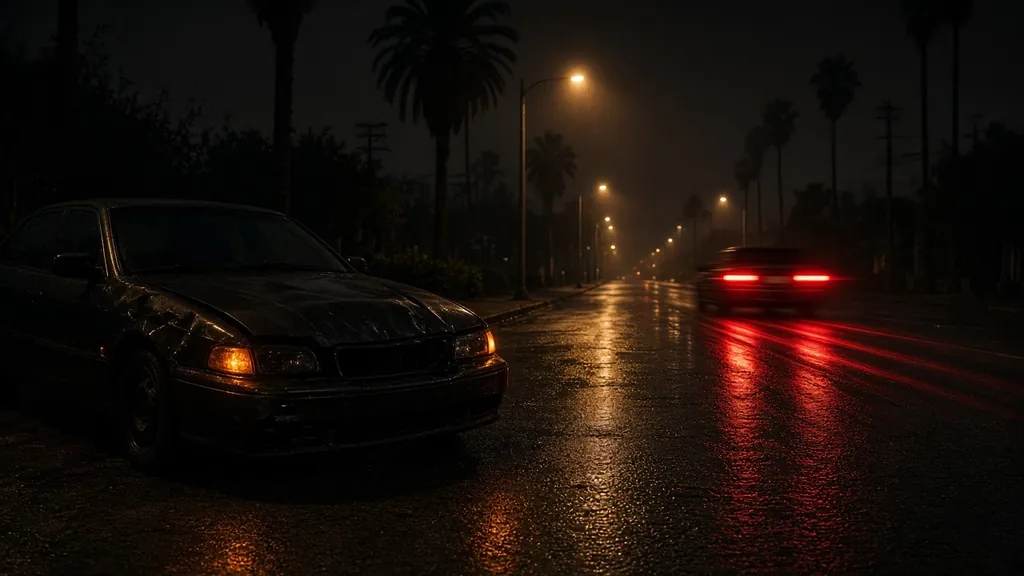
Somebody hit you and kept going. Or they stopped, and it turns out they don’t have insurance. Either way, the person who caused the crash may have nothing to pay with. That’s the gap uninsured motorist coverage fills, and in California the rules for it are in one long statute, Insurance Code § 11580.2. Here’s how it works.
What UM coverage is
Uninsured motorist coverage pays you, within your policy limits, the damages you’d be “legally entitled to recover” for bodily injury from the owner or operator of an uninsured vehicle (§ 11580.2(a)(1)). It’s a claim on your own policy, not a lawsuit against your own insurer for causing the crash.
- It comes with the policy by default. A bodily-injury liability policy issued in California must include UM coverage. You and the insurer can agree in writing to delete it, delete it for named drivers, or lower the limits, but not below the state’s financial-responsibility minimums (§ 11580.2(a)(1)–(3)).
- Limits. UM must be offered at limits equal to your bodily-injury liability limits, though the insurer doesn’t have to offer more than $30,000 per person and $60,000 per accident (§ 11580.2(m)). For policies issued or renewed on or after January 1, 2025, the minimum liability limits are $30,000/$60,000 for injury and $15,000 for property damage (Veh. Code § 16056(a)(2)).
- Who’s covered. If the named insured is an individual, “insured” includes the named insured, a spouse, and relatives living in the same household, whether they’re in a vehicle “or otherwise.” It also includes anyone in or getting in or out of the insured vehicle (§ 11580.2(b)). So UM can matter when you’re hit as a pedestrian, too.
Pull your declarations page to see whether you have UM, and at what limits. If you deleted or lowered it in writing, that agreement generally carries over to renewals and replacement policies with the same insurer (§ 11580.2(a)(1)).
What counts as an “uninsured motor vehicle”
Under § 11580.2(b), it’s broader than “no insurance at all.” It includes a vehicle:
- with no bodily-injury liability insurance or bond at the time of the crash;
- whose insurer denies coverage, or admits it only conditionally or with a reservation;
- that is “underinsured,” as defined in § 11580.2(p) (more below);
- used without the owner’s permission, if there’s no applicable coverage; or
- whose owner or operator is unknown, which is the hit-and-run case, if the conditions in the next section are met.
A vehicle owned or operated by the named insured or a member of the same household isn’t “uninsured” under this section.
Hit-and-run: the three conditions
When the driver can’t be identified, § 11580.2(b) treats the vehicle as uninsured only if:
- Physical contact. The injury must have “arisen out of physical contact” of the unidentified vehicle with you, or with the vehicle you were in (§ 11580.2(b)(1)). A driver who ran you off the road without touching you is a harder case under this wording.
- A police report within 24 hours. You or someone for you reported the crash within 24 hours to the police department of the city where it happened or, in unincorporated areas, to the county sheriff or the local CHP office (§ 11580.2(b)(2)).
- A sworn statement within 30 days. Within 30 days after that, you filed with your insurer a statement under oath that you have a claim against a person whose identity is unknown, with facts supporting it (§ 11580.2(b)(2)).
Those time limits are short, and they start right after the crash. Separately, the Vehicle Code requires any driver involved in an injury crash, including the driver who was hit, to make a written report to the CHP or city police within 24 hours (Veh. Code § 20008(a)). The driver who leaves breaks a different law: drivers in injury crashes must stop and do what § 20003 and § 20004 require (§ 20001(a)).
In the City of Los Angeles, LAPD says to call 911 if anyone is hurt. For a hit-and-run with no injuries, it lists a non-emergency line and an online report option for insurance purposes on its traffic collision questions page.
Underinsured drivers
A driver can have insurance and still not have enough. Under § 11580.2(p), an “underinsured motor vehicle” is one that is insured, but for less than the UM limits on the injured person’s vehicle. A few rules shape these claims:
- Exhaustion first. Underinsured coverage doesn’t apply until the at-fault vehicles’ liability limits have been used up by judgments or settlements, and proof of payment goes to your insurer (§ 11580.2(p)(3)).
- Credit for what was paid. Your insurer’s maximum is your underinsured limit minus what was paid to you by or for anyone legally liable (§ 11580.2(p)(4)).
- Keep your insurer in the loop. If you sue the underinsured driver, you must promptly give your own insurer a copy of the complaint by personal service or certified mail (§ 11580.2(p)(6)).
UM and underinsured coverage are offered as a single coverage, and underinsured limits can be higher (§ 11580.2(n)).
Arbitration, not a jury
Whether you’re legally entitled to recover, and how much, is decided by agreement with your insurer or, if you disagree, by arbitration before a single neutral arbitrator (§ 11580.2(f)). The insurer can ask for wage information, medical-record releases, and a medical exam on set timelines (§ 11580.2(o)).
The two-year rule, and it’s not the usual one
Most injury lawsuits have a two-year statute of limitations (see the two-year deadline). UM claims have their own trigger. Under § 11580.2(i)(1), no claim accrues under the policy unless, within two years from the date of the accident, one of these has happened:
- a lawsuit for bodily injury has been filed against the uninsured motorist;
- you and your insurer have agreed on the amount due; or
- you have formally started arbitration by written notice to the insurer, sent by certified mail, return receipt requested.
Once started, arbitration generally must finish within five years, with a longer window if there’s a related workers’ comp claim (§ 11580.2(i)(2)). If you have a pending UM claim and no lawyer, your insurer must warn you in writing about the deadline at least 30 days before it runs. If it doesn’t, the deadline is tolled until 30 days after the notice is actually given (§ 11580.2(k)).
What about the car?
Damage to your vehicle runs under a different statute. Insurers must offer uninsured-motorist property damage coverage, which either pays your collision deductible or, if you don’t carry collision, pays up to the car’s actual cash value or $3,500, whichever is less (§ 11580.26(a)). It’s narrower than bodily-injury UM: it requires actual, direct physical contact, the other driver identified or the vehicle identified by license plate, a report to your insurer within 10 business days, and, if you disagree, arbitration started within one year (§ 11580.26(b)). A true unknown hit-and-run, with no plate, generally falls outside it. Your collision coverage, if you have it, is a separate question.
Where to go from here
UM claims turn on policy language and deadlines that start running on day one. For advice about your own claim, consider talking with a licensed California attorney. The State Bar lists certified lawyer referral services. The California Department of Insurance has consumer information on auto insurance and how to ask it for help with an insurer.
Sources
- Insurance Code § 11580.2 (uninsured and underinsured motorist coverage)
- Insurance Code § 11580.26 (uninsured motorist property damage)
- Vehicle Code § 16056 (minimum liability limits; $30k/$60k/$15k from 2025)
- Vehicle Code § 20001 (duty to stop: injury crashes)
- Vehicle Code § 20003 (duty to give information and aid)
- Vehicle Code § 20004 (duty in fatal crashes)
- Vehicle Code § 20008 (24-hour written report)
- LAPD: Traffic Collision Questions
- California Department of Insurance: Consumer Information
Statutory text checked on leginfo.legislature.ca.gov on Nov 15, 2026.